
The Hidden Tax Trap of 401(k) Withdrawals
Withdrawing money early from your 401(k) is usually a financial disaster. Once you add federal tax, the 10% penalty, and Massachusetts state tax, the real tax hit is often 37% or more. Before you tap into your retirement to buy a home or pay off debt, read this first.
Why I’m Writing This
In all my years as a tax attorney in Lowell, I have sent one mass email to my entire client list.
It wasn’t a holiday message.
It wasn’t a newsletter.
It was this warning.
Why? Because I keep seeing good, hardworking people destroy their long-term wealth after getting bad advice from an HR department or a 1-800 customer service line.
The conversation is always the same.
A client sits across from me in April.
I tell them they owe thousands in taxes.
They look shocked and say:
“But I already took the tax out. The lady on the phone said they withheld 20%.”
I hate delivering that news.
So let me explain it now — while you can still avoid the damage.
1. The Big Myth: “The 20% Withholding Covers It”
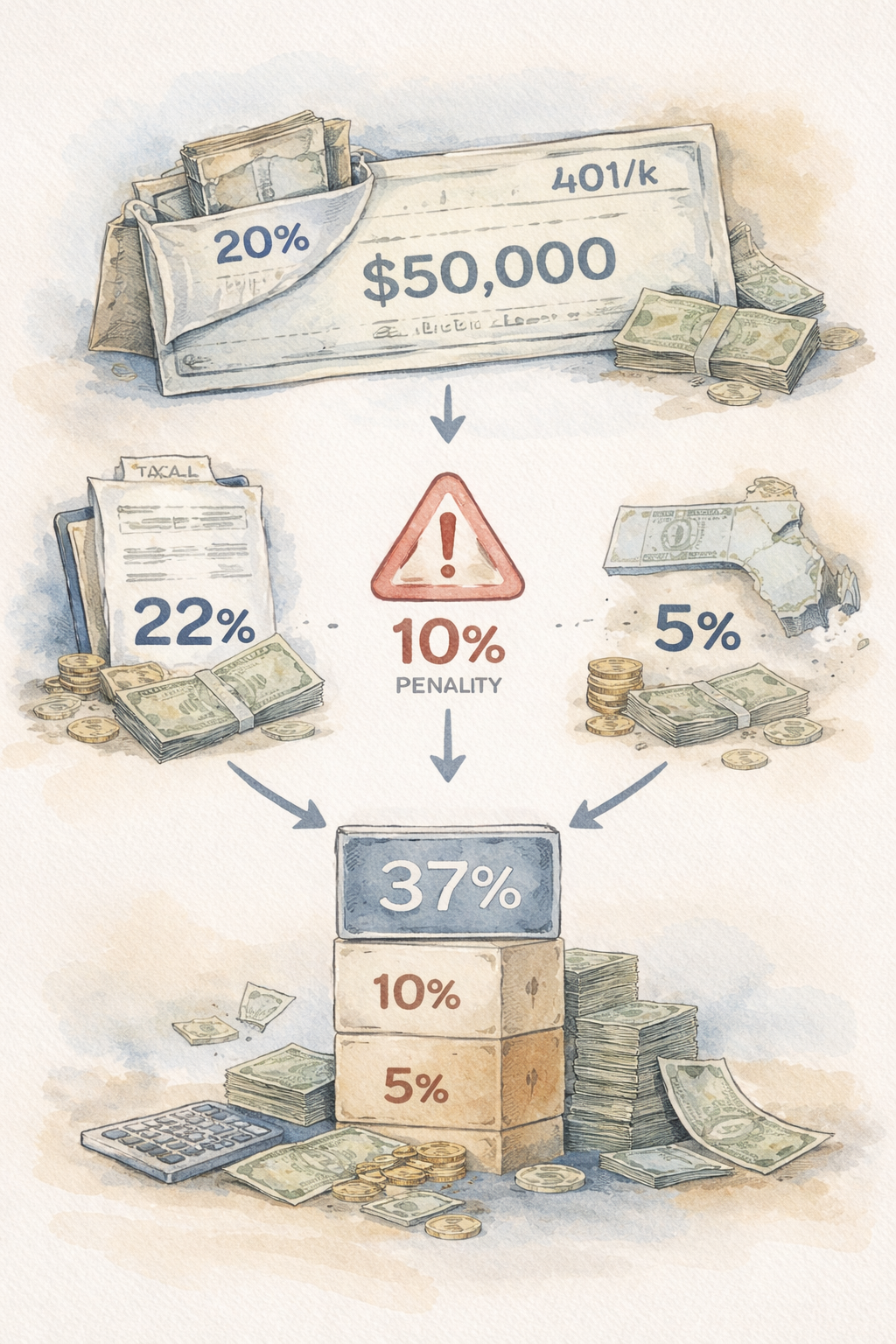
When you take an early 401(k) withdrawal, the plan administrator is required to withhold 20% for federal taxes.
Most people think that means:
“Taxes paid. Done.”
It is not done.
That 20% is just a down payment.
Here’s what’s missing:
Federal Income Tax
If you’re still working, adding a $50,000 withdrawal on top of your salary often pushes you into the 22% or 24% tax bracket. You’re already short.
The 10% Early Withdrawal Penalty
Unless you meet a very narrow exception, you owe this penalty — and the 20% withholding does not cover it.
The Massachusetts Surprise
Most 401(k) companies withhold nothing for Massachusetts.
Massachusetts still wants its 5%.
The Real Math
22% Federal tax
10% Penalty
5% Massachusetts tax
= 37% total tax rate (often higher)
They withheld 20%.
You owe around 37%.
Come April, I’m the one who has to tell you about the gap.
2. The Down Payment Disaster
($80,000 Gone to Get $50,000)
I see this constantly.
A young couple wants to buy a home in the Merrimack Valley.
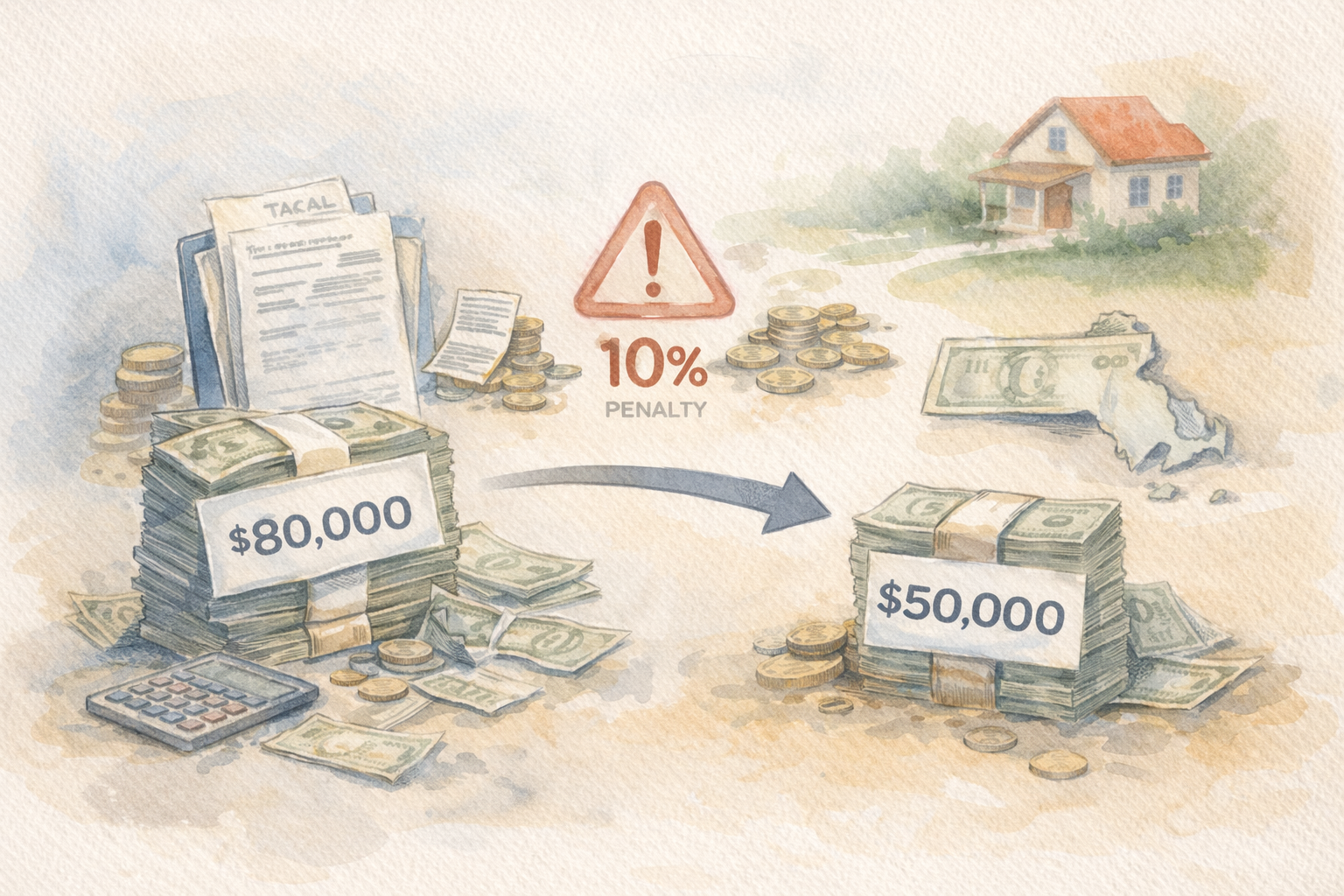
They need $50,000 for a down payment.
They withdraw $50,000 from their 401(k).
Here’s what happens:
Taxes and penalties come to roughly $18,500
To actually net $50,000 in cash, they have to withdraw close to $80,000
That’s $80,000 of hard-earned retirement savings gone — instantly.
Retirement planners hate this.
And for good reason: you’re burning decades of compounded growth just to get cash today.
A Smarter Alternative: The “Dad Loan”
I once ran these numbers with a young client and his father.
When the father realized his son was about to lose $30,000 just to access his own money, he immediately offered a small family loan to bridge the gap.
The son hadn’t asked because asking family for help feels uncomfortable.
Withdrawing from a 401(k) feels “easy.”
Don’t do the easy thing.
Do the smart thing.
3. The “First-Time Homebuyer” Myth
This one drives me crazy.
Many people believe that withdrawing from a 401(k) to buy their first home is tax-free.
It is not.
You still owe income tax.
Some people think it’s at least penalty-free.
Also not true.
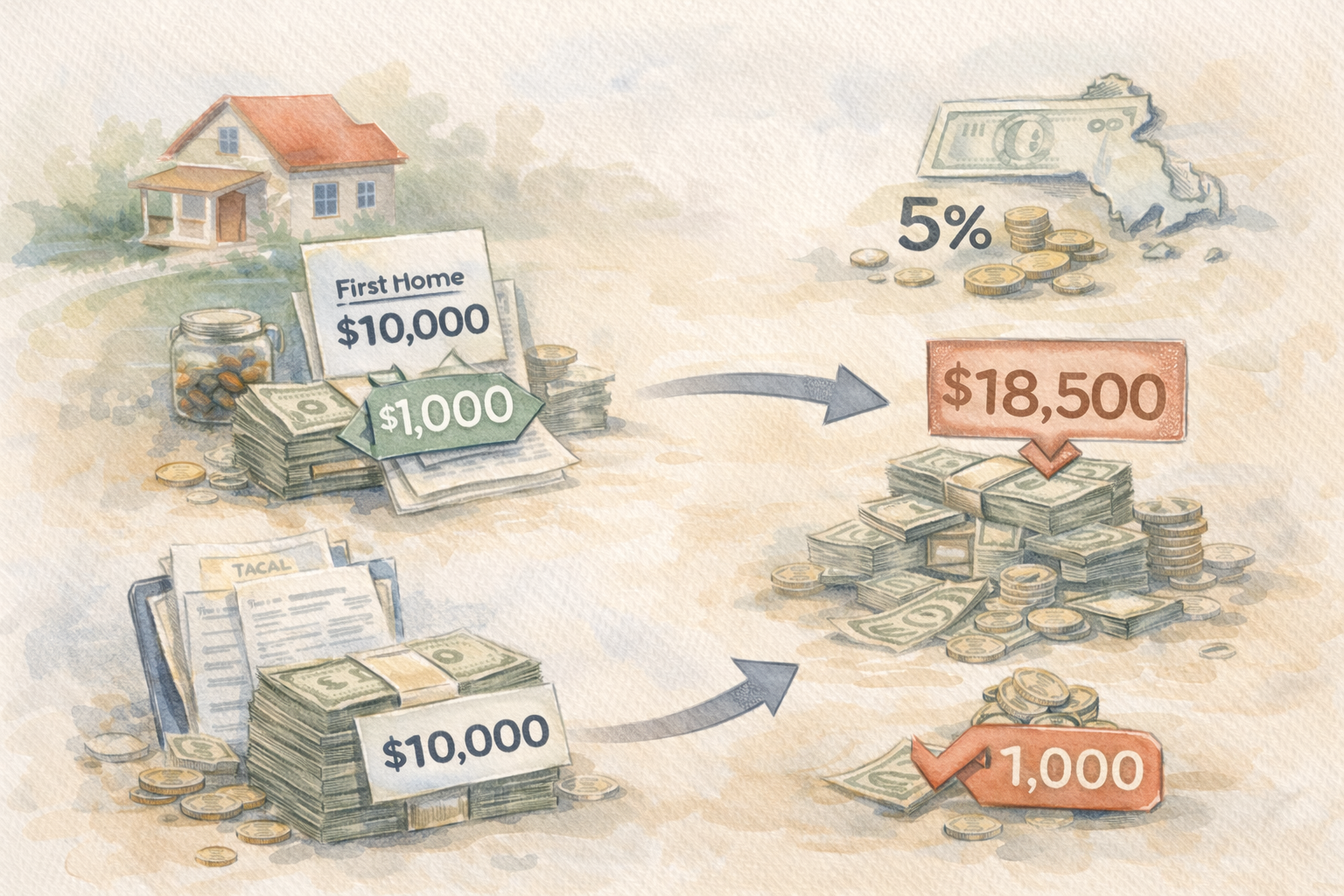
There is a first-time homebuyer penalty exception — but it’s capped at $10,000.
That saves you $1,000.
Nothing wrong with saving $1,000.
But when the total tax bill is $18,500, that’s not exactly a great deal.
4. The Job-Change Trap
When a 401(k) Loan Explodes 💣
Many people try to be smart and take a 401(k) loan instead of a withdrawal.
That can be a good strategy — until you leave your job.
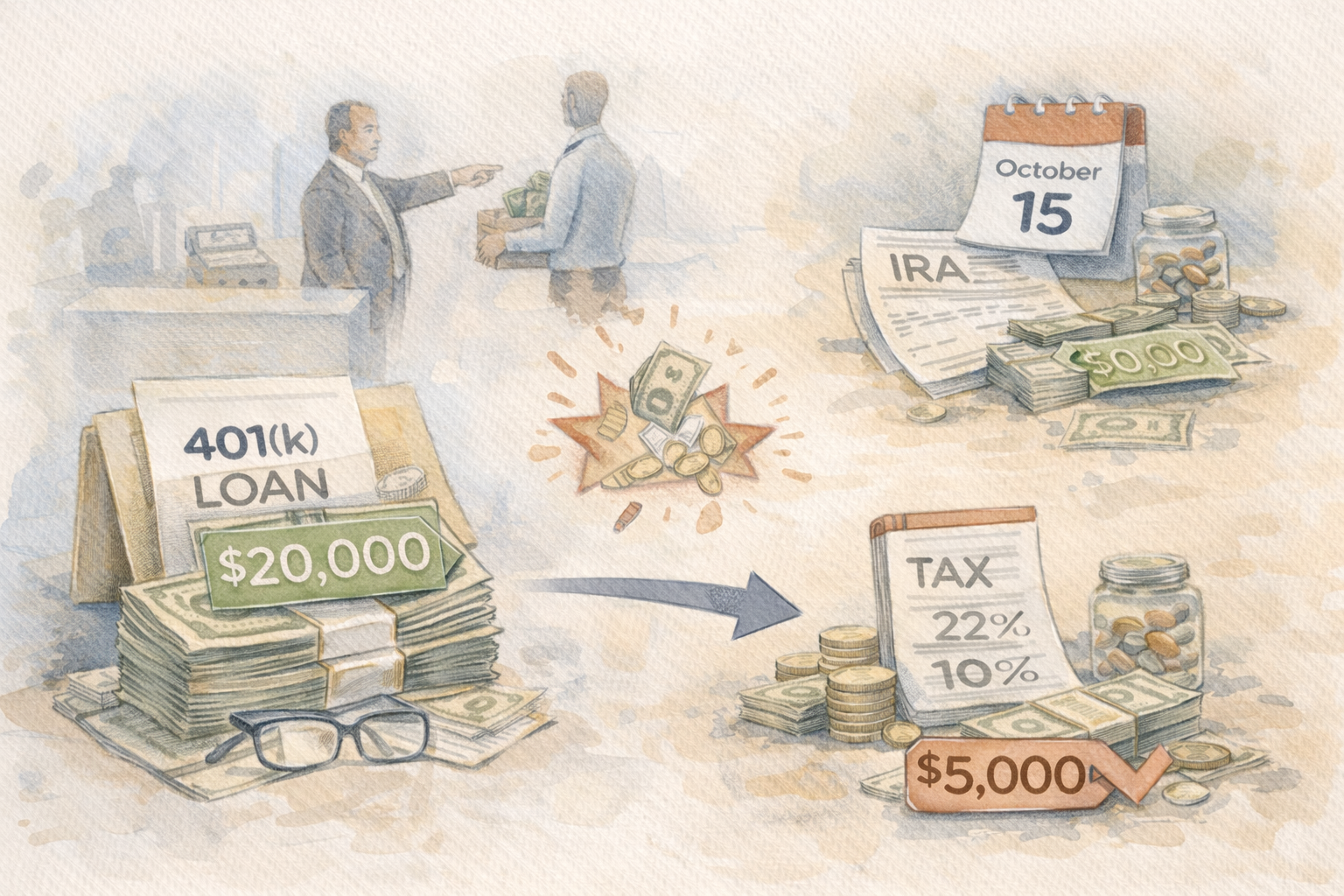
If you quit or get fired, the loan often becomes due almost immediately.
If you can’t repay it, the entire balance turns into a taxable distribution 💥
That means:
Income tax
Possible penalties
A surprise bill you weren’t planning for
The October 15th Escape Hatch 🗓️
If this happened to you, don’t panic.
You still have time to fix it. It is called a “Qualified Plan Loan Offset” (QPLO ) Roll Over IRA.
If you left your job in 2026, you generally have until October 15, 2027 ( the tax filing extension deadline) to roll over the loan offset amount into an IRA.
The Key Point Most People Miss ❗
This is not an all-or-nothing situation.
If your loan was $20,000 and you can only come up with $5,000, deposit the $5,000.
✅ You avoid taxes and penalties on that portion.
Every dollar you roll over reduces the damage.
I’ve seen clients save thousands of dollars by scraping together even a small amount once they understood the math. For example, if you live in Massachusetts, are under the age of 59 ½ and are in the 22% tax bracket, just depositing ½ of the $20,000 loan offset, which saves a taxpayer $3,700. In the $ 5,000 example I gave, the tax savings would be $ 1,850.