
"No" Property Damage, Real Injury: How We Won a $60,000 Settlement
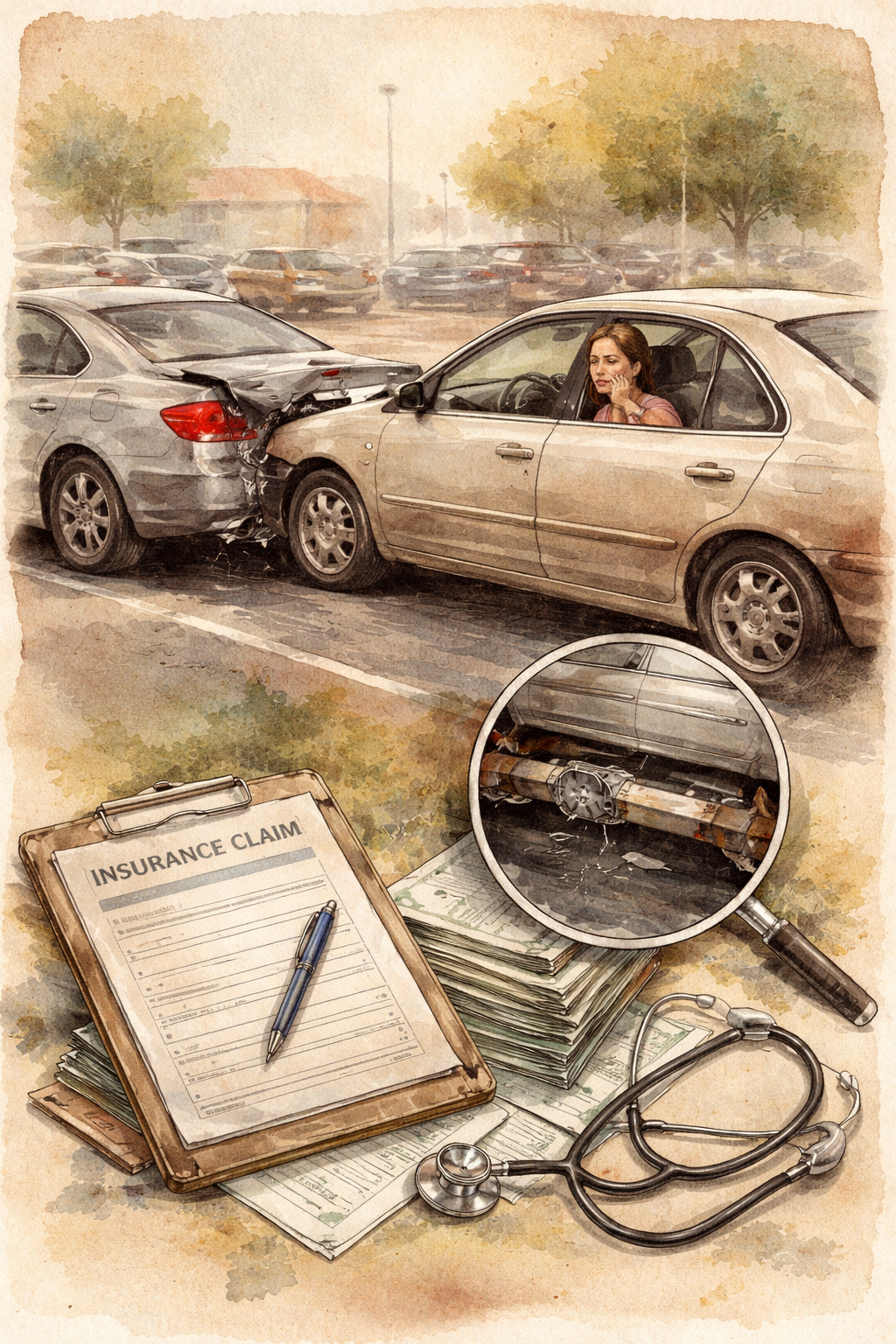
Insurance companies love to argue that if there’s no property damage, there must be no injury.
And if there’s only a little property damage, they insist there can’t be more than a little injury.
Neither statement is actually true.
But convincing an insurance company of that can be an uphill battle—especially when they’ve already decided what story they want to tell.
No case illustrates this better than one I handled a few years ago.
The “No Damage” Case That Ended in a $60,000 Settlement
My client was a middle-aged woman who was a passenger in a car that got rear-ended in a parking lot. Liability could not have been clearer. It was as straightforward as they come.
Then the insurance company appraised the car.
Their appraiser claimed there was no damage.
Now, the car wasn’t new. The bumper wasn’t pristine before the crash, so it was easy for the appraiser to shrug and say, “None of this is from the accident.” And that was their excuse to push the same argument insurers love to use:
“No damage = no injury.”
Meanwhile, my client treated extensively and incurred significant medical bills. She even went to an “independent” medical exam—run by the insurance company—where the doctor acknowledged she was injured and confirmed her treatment was reasonable and necessary. Her own PIP carrier paid the full $8,000 in medical benefits.
Even with all that, the other driver’s insurance company denied the claim.
Their position was simple: no property damage, therefore no injury.

Two Lawyers Quit on Her
First, she hired a heavily advertised law firm that bragged about its size and how many billions of dollars it had “recovered.” After more than a year of getting nowhere, that firm told her to go find another attorney.
So she did.
She phoned another attorney who also advertised extensively. But the insurance company refused to budge, and the second lawyer eventually sent her a letter terminating representation as well.
At that point, she was more than two years out from the crash and had essentially been abandoned—twice.
Fortunately, she had a friend who used to be my client. That friend suggested she come see me.
And she did.
The Car Was Still in Her Driveway
Here’s the key detail: even though it had been more than two years, she still had the same car.
It had never been repaired.
No further accidents.
Nothing else that could explain any new damage.
So I asked her to bring it to my office so I could look at it personally.
Most lawyers don’t do that. But I do—because I actually went to auto damage appraisal school.
I did that for one reason: I’ve seen too many cases where insurers lowball the property damage appraisal and then use that low appraisal as leverage to lowball (or deny) the injury claim.
What the Appraiser “Didn’t See”
When I looked at the car, I immediately noticed something was off.
The lines were wrong.
Specifically, the trunk lid was misaligned—one side had a noticeably different gap than the other. That doesn’t happen because of age or “normal wear.”
The frame had twisted.
I’m confident the appraiser saw it.
He just chose not to see it.
The “Supplement” That Changed Everything
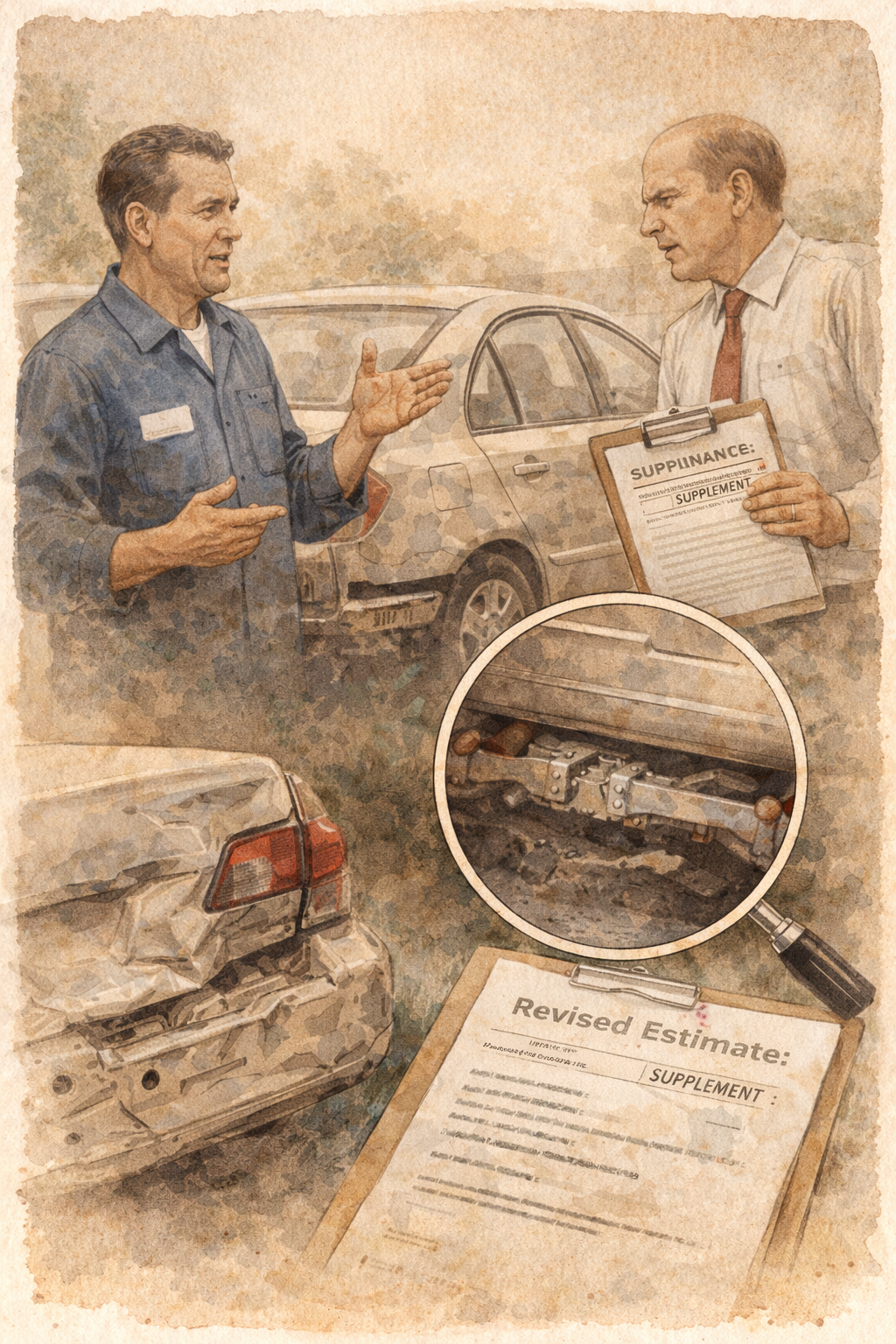
I called a local body shop owner who I trust—someone who is excellent at pushing back against insurance company appraisers. He brags that he always gets a supplement, and from what I can tell, he does.
Of course, this is a very low bar, because insurance appraisers always always always—100% of the time—always lowball the first appraisal.
He came out, looked at the car, and agreed with me: the misalignment was real, and it was accident-related.
He called the insurance appraiser and demanded what’s typically called a “supplement.”
And yes—the original estimate was zero, so calling it a supplement almost felt ridiculous. But terminology aside, the goal was simple:
Get a positive number on paper.
The appraiser fought it at first, because the damage was over two years old. They tried the predictable argument:
“How do we know this came from this accident?”
But in the end, the appraiser issued a revised estimate. It wasn’t perfect, and it still wasn’t enough—but it didn’t need to be.
The amount wasn’t the point.
The point was this:
I no longer had to listen to an adjuster saying,
“There was no damage, so there can’t be an injury.”
Now there was documented damage. And with that, their entire excuse collapsed.
The Result
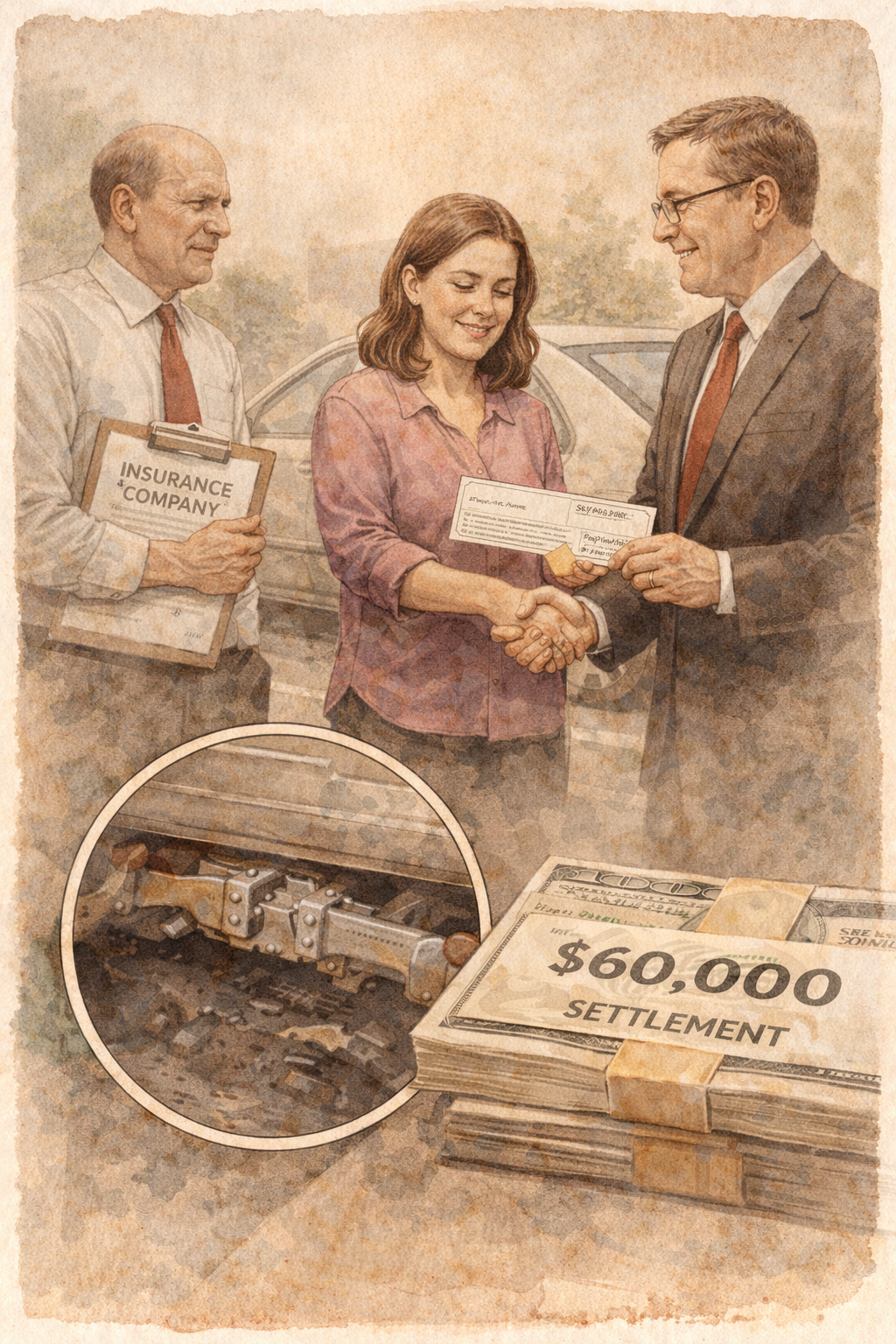
I settled the claim for $60,000.
No lawsuit.
No trial.
No unnecessary drama.
Just a fair settlement—based on facts.
The car had no obvious visible damage, and even the final appraisal was still too low. But once we established that there was real structural damage, the insurance company no longer had any good-faith basis to deny the injury or ignore their own doctor’s findings.
Two other lawyers had this case for more than two years and recovered nothing.
I had it for a couple of months and recovered $60,000.
The difference wasn’t luck.
The difference was understanding motor vehicle property damage in a way most lawyers don’t.
If the insurance company is denying your injury claim because they say there’s “no damage,” call us.
We know what to look for, and we know how to prove it.
📞 Call or text (978) 459-8359
📍 16 Pine Street, Lowell, MA (Unit 2)
Want more information?
Download our free eBook and learn the steps that protect your case from day one.